Apr 21, 2026
Billing in HALO
Turn operational activity into charges, automatically
In ground handling, billing typically begins only after the operation is over. Once a flight departs and ramp activity is complete, Finance starts working to determine what happened, what services were delivered, and what can actually be invoiced. The problem is that operations and billing are usually managed in separate systems. Operations teams work across task tools, dispatch systems, and service logs, while Finance works from contract terms, spreadsheets, and billing platforms. By the time invoicing begins, someone has to reconstruct the operation after the fact.
That reconstruction is where revenue is lost. Services are missed, contract terms are applied inconsistently, and Finance spends time validating activity instead of closing the period. In many operations, this leads to meaningful revenue leakage, often reaching 10% or more of station revenue. The issue is not the contract or the work itself. It’s that the operational record and the billing record are not connected. This impact is measurable, and can be modeled using our ROI calculator.
With HALO, Finance works with what was already captured from the operation.
Introducing HALO's billing vertical
HALO’s billing vertical automatically turns what happens on the ramp into charges. It is the first capability of its kind in this industry, built directly on top of operational data. This is not just a better invoicing tool, but a fundamentally different way of approaching this part of the problem.
As services are performed, HALO records operational events tied to that work, including completed tasks, equipment usage, photos, and timestamps. These become part of the flight’s operational record, creating a continuous source of truth from the moment a turn begins. Billing logic maps directly to those events, so when a qualifying service occurs, the corresponding charge is generated automatically.
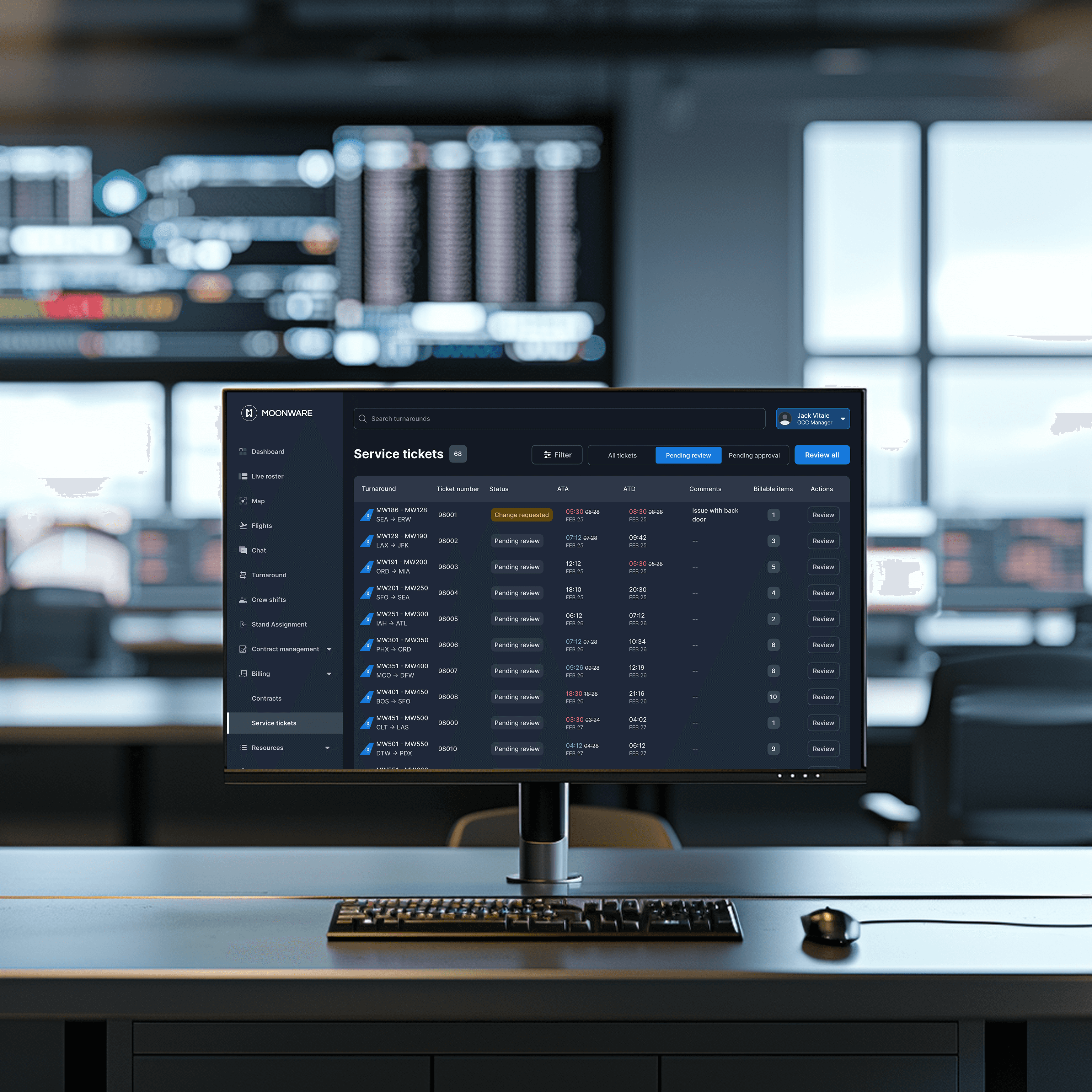
When a turnaround closes, the billing engine generates a service ticket based on contract rules. A controller reviews the ticket, confirms or adjusts the charges, and submits it for approval. Finance then reviews what HALO has already built, rather than reconstructing what needs to be invoiced.
A fundamental shift in how billing works
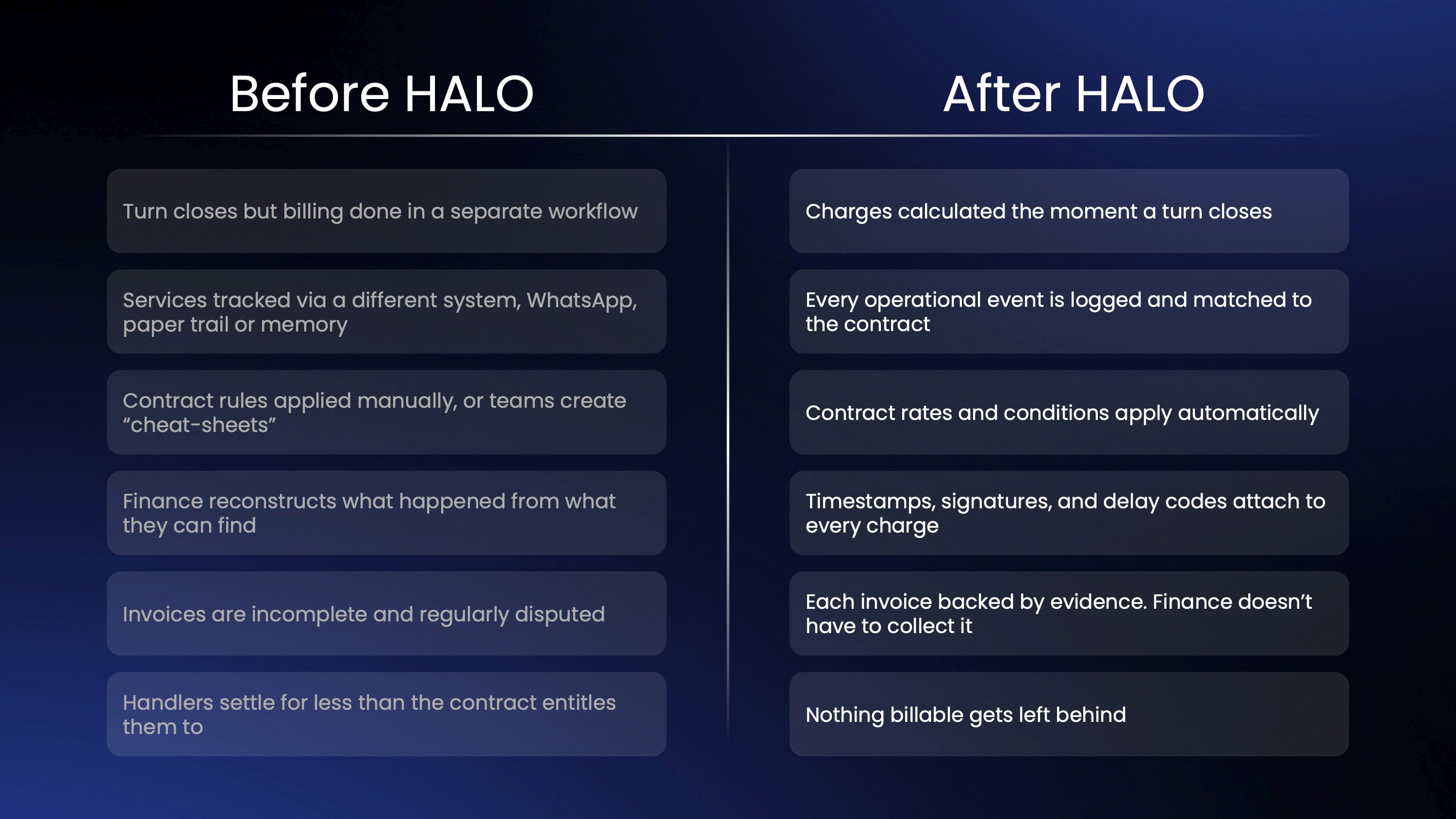
In most ground handling operations today, turnarounds close but billing happens later through a separate workflow, often hours or days afterward. Services are tracked across disconnected systems, WhatsApp group chats, paper trails, or memory. Contract rules are applied manually, often from printed rate sheets or informal team cheat sheets. By the time Finance is ready to invoice, the operational record is incomplete, charges are missing or hard to support, and handlers often settle for less than their SGHA contract entitles them to.
With HALO, charges are calculated the moment a turnaround closes. Every operational event is recorded and matched automatically against contract terms. Timestamps, signatures, and delay codes are attached to each charge as it occurs, so every invoice is backed by a complete operational record that Finance did not have to reconstruct.
What this looks like in practice
Delay billback
A flight is delayed by 95 minutes, above an SGHA threshold of 60. HALO recognizes the delay, calculates the additional labor charge, and generates the billable item automatically. Previously, this was often missed entirely or settled without the evidence needed to support it.
Additional equipment usage
An airline requests an airstart. HALO dispatches the operation, captures the service event, applies the contracted rate, and routes it for digital sign-off. Previously, this type of service was often missed or relied on a paper trail that never made it to Finance.
Late cancellation
A flight cancels within the contractual notice window. HALO records the notification timestamp and applies the penalty automatically based on contract terms. Previously, the timestamp was not formally captured, making the charge difficult to defend.
Pay-sell labor
A flight is delayed and two agents work overtime beyond the contracted baseline. HALO captures the additional hours, applies the contracted rate, and routes them for customer sign-off. Previously, these hours were either reconciled manually at the end of the period or missed altogether.
What this means for your operation
Capture revenue that already exists
Ground operations teams can lose up to 10% of station revenue per period, not because the work was not done, but because it was not captured at the source. HALO closes this gap by converting operational events into billable items in real time, before anything is missed.
Make every charge defensible
Invoice disputes happen when Finance cannot verify what occurred on the ramp. HALO automatically attaches timestamps, photos, signatures, and operational records to each charge, so every invoice is backed by evidence. For airlines reviewing those invoices, this reduces time spent on disputes and speeds resolution when they do occur.
Remove the work between operations and billing
When a turn closes, charges are calculated against contract terms and are immediately ready for review. There are no spreadsheets to maintain and no operational events to reconstruct after the fact.
Keep pricing where it belongs
Contract rates and billing rules remain within Finance, while operations teams see only what they need to execute the work. The two stay separate, with visibility shared only where it is relevant.
Part of something larger
HALO’s billing capability is the first in a broader set of capabilities being built into the platform. Core capabilities such as real-time resource allocation, mapping, communications, and performance create the operational foundation. These new capabilities build on that foundation, using operational data to support parts of the business that today rely on separate tools, manual workflows, or dedicated back-office processes. Billing is the first. More will follow.
Get in touch to book a demo and see how HALO’s billing capability fits into your operation.